Paper money, Bonds and Shares
Lot 136:
Description
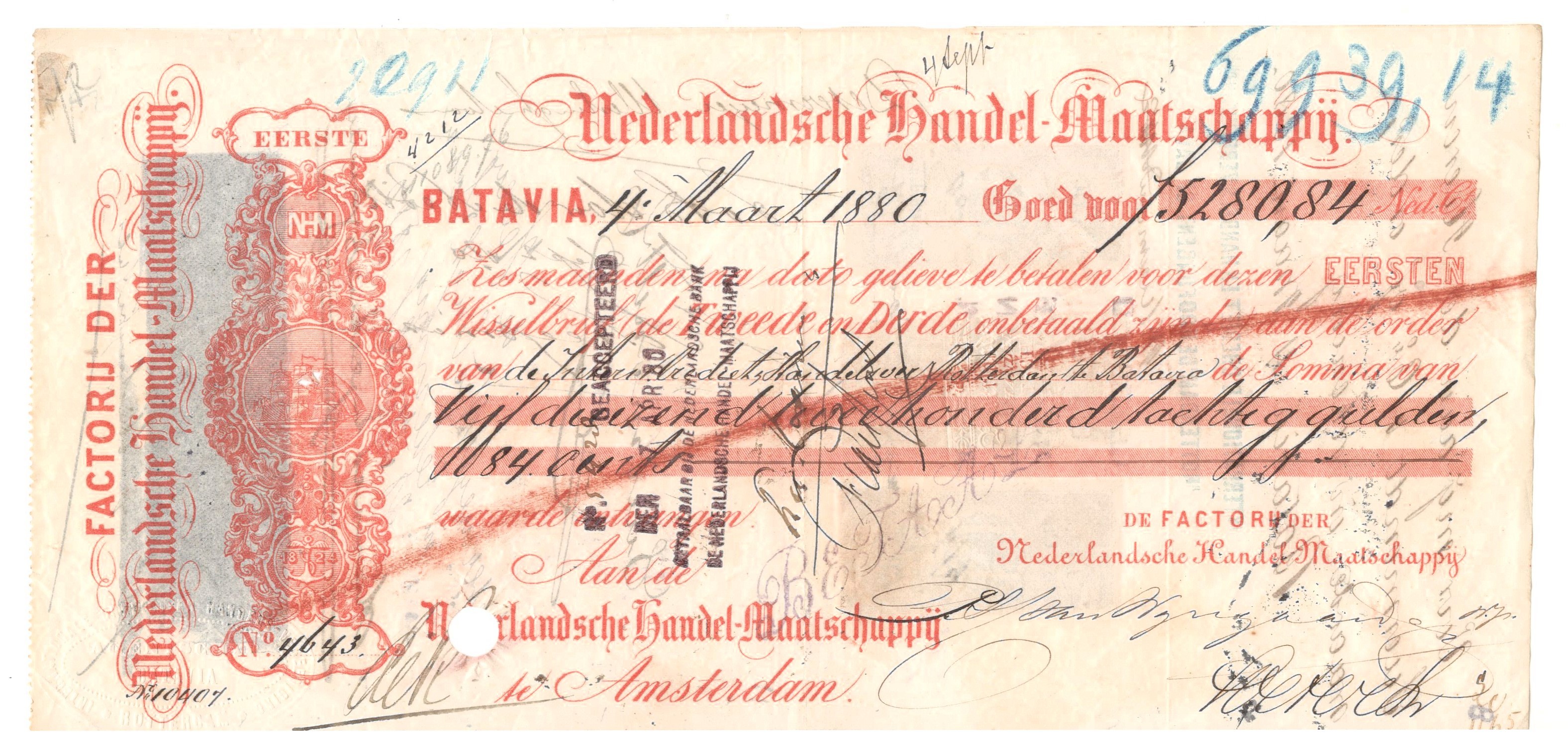
This rare 1880 bill of exchange, issued by the Nederlandsche Handel-Maatschappij (Netherlands Trading Society) in Batavia (modern-day Jakarta, Indonesia), is a significant artifact from the colonial trade era. Founded in 1824 by King Willem I of the Netherlands, the NHM was initially created to promote trade between the Netherlands and its colonies, particularly the Dutch East Indies. This bill represents a financial transaction tied to the vast global trading network facilitated by the NHM, one of the most influential trading and financial institutions of its time.
The Nederlandsche Handel-Maatschappij was established to rebuild and expand the Dutch economy after the Napoleonic Wars. The NHM became central to the economic exploitation of the Dutch East Indies, facilitating the transport and sale of valuable commodities such as sugar, coffee, tea, and spices. Its operations extended beyond trade, evolving into a significant financial institution that later merged with Twentsche Bank in 1964 to form the ABN Bank, a predecessor of today’s ABN AMRO.
This 1880 bill of exchange is an exceptional piece of financial and colonial history. Its association with the Nederlandsche Handel-Maatschappij, one of the most influential trading organizations in the Netherlands, makes it highly desirable to collectors of historical financial documents. The vibrant design, including the engraved sailing ship, serves as a testament to the NHM’s maritime dominance and its crucial role in global trade.
Share this lot: